
Your deck now has a shape.
Deck Forecast is a new Deck Scorer view that breaks your list into turn windows and shows when your deck is actually doing its work: board presence, attack output, HP coverage, repair, card draw, breach pressure, and more.
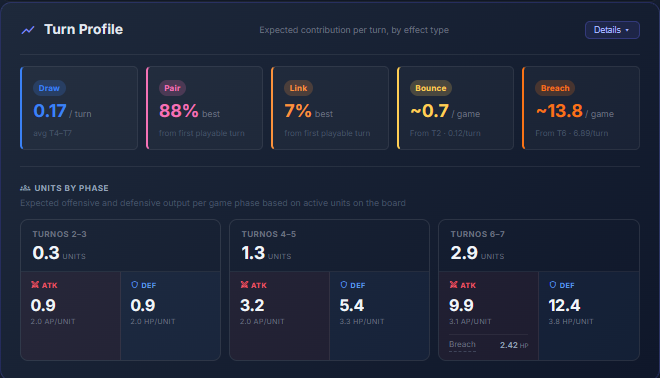
What Deck Forecast shows
The scorer groups your deck's expected output into four game windows: Turn 1, Turns 2-3, Turns 4-5, and Turns 6-7. Each window gives you a practical read on what your deck is likely to contribute at that point in the game.
- Board presence: how many units your deck expects to put into play.
- Attack output: how much pressure your deck can create.
- HP coverage: how much board durability your units provide.
- Repair and defense: how well your list can stabilize or protect its board.
- Card draw and value: how often your deck can keep resources flowing.
- Breach pressure: how much direct pressure your deck can apply through defensive boards.
- And all your beloved effects!
Why timing matters
A deck can have strong cards and still fail if those cards matter on the wrong turns. Deck Forecast helps answer a more useful question than "is this card good?" It asks: is my deck strong when my strategy needs it to be strong?
An aggressive deck should usually peak early, especially around Turns 2-3. A control deck may look quiet at first, then grow into Turns 4-7. A midrange deck should show a smoother curve, with enough early presence to avoid falling behind and enough late-game output to finish.
If your Turns 6-7 profile looks almost identical to your Turns 2-3 profile, your deck may not have a real late game. It may just have more of the same midgame.
How to use it while deckbuilding
Deck Forecast is most useful when you compare the graph against your deck's game plan.
- If your aggro deck has low early attack output, it may need cheaper pressure.
- If your control deck never improves after Turn 4, it may lack finishers or scaling value.
- If your list has good units but low draw, it may run out of gas before the turns where it wants to win.
- If your board looks strong but breach pressure is missing, you may struggle to close games through blockers.
This does not replace testing. It makes testing smarter. Instead of guessing why a deck feels slow, flat, or fragile, you can look at the turn window where the problem starts.
A new layer for Deck Scorer
Deck Forecast is part of Gundambay's larger goal: making deckbuilding easier to understand, compare, and improve. The goal is not to reduce a deck to a single number. The goal is to show the shape of the deck, so players can spot strengths and weaknesses before sitting down for games.
Patreon support helps fund features like this: deeper analysis tools, better simulations, matchup reports, and more ways to turn raw decklists into useful information.
Coming next: head-to-head deck comparison, so you can run two decks against each other and see which one wins on paper before you sleeve up.